



The Short Version
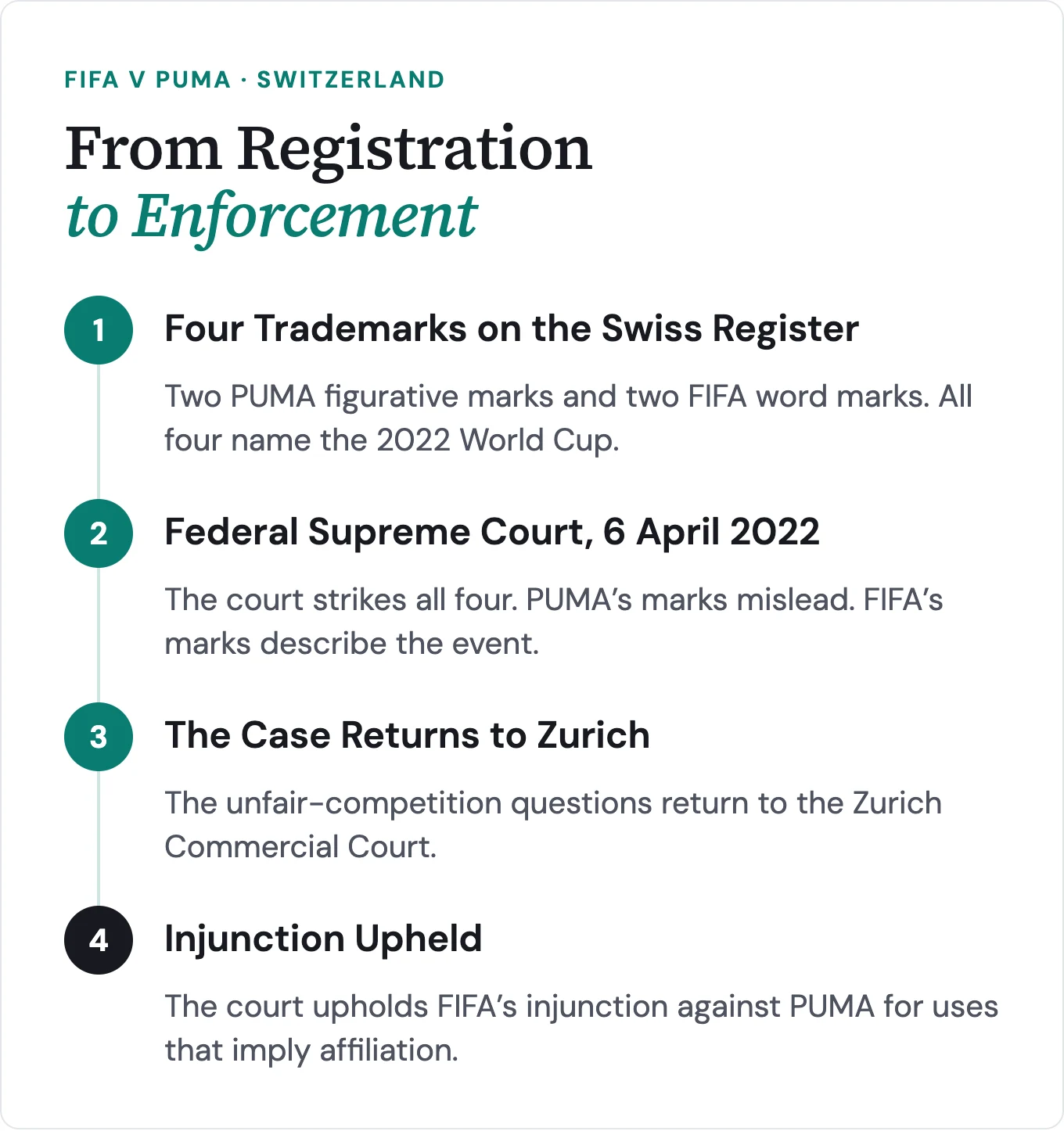
On 6 April 2022, the Swiss Federal Supreme Court decided consolidated cases 4A_518/2021 and 4A_526/2021, often shorthanded as FIFA v PUMA. The Court struck four registrations from the Swiss register: two PUMA figurative marks ("PUMA WORLD CUP QATAR 2022" and "PUMA WORLD CUP 2022") as misleading under Art. 2(c) of the Trade Mark Protection Act (TmPA), and two FIFA word marks ("WORLD CUP 2022" and "Qatar 2022") as descriptive and in the public domain under Art. 2(a). On remand, the Zurich Commercial Court upheld FIFA's injunction against PUMA for uses that implied affiliation. For non-sponsors planning 2026 campaigns: bare event names remain free to describe the event, but pairing them with your brand in a way that signals an official tie is a fast route to refusal, cancellation, and injunctive relief.
Why Both Sides Lost, on Different Legal Grounds
PUMA: Misleading Combination Under Art. 2(c) TmPA
PUMA's figurative marks combined its house brand with the event name: "PUMA WORLD CUP QATAR 2022" and "PUMA WORLD CUP 2022". The Supreme Court assessed the overall impression and concluded that this pairing suggested a special relationship (sponsorship, partnership, or another official link) with the event organizer. Because PUMA had no such relationship for the tournament at issue, the trademarks were inherently misleading and excluded from protection under Art. 2(c) TmPA.
Practical point: the public-domain status of "World Cup 2022" does not give non-sponsors a free pass to trademark or headline it alongside their brand if that creates the appearance of endorsement. The test is not what the brand owner intends, but what the sign communicates to average Swiss consumers in context.
FIFA: Descriptive and Public Domain Under Art. 2(a) TmPA
FIFA's own word marks, "WORLD CUP 2022" and "Qatar 2022", fell for the opposite reason: the Court viewed them as descriptive of the event, and therefore within the public domain. Standing alone, they lacked inherent distinctiveness at filing. Nor could FIFA rely on acquired distinctiveness, as the trademarks had not yet been used to the extent required to establish secondary meaning at the relevant time. Under Art. 2(a) TmPA, such signs must remain free for everyone to use to describe the event.
This clarification, apparently the first from Switzerland's top court on event names, draws a clean line: bare event names and dates are not monopolizable by the organizer unless and until distinctiveness through use is proven.
The Remand: The Injunction Confirms the Enforcement Risk
Although FIFA lost its bare word marks, the case did not end there. The Supreme Court remitted the unfair-competition issues to the Zurich Commercial Court. On remand, that court upheld FIFA's injunction against PUMA for non-sponsor use that, in context, implied affiliation. The takeaway is straightforward: you can neither register nor use a sign in commerce in a way that leads consumers to believe you are officially connected when you are not. Trademark and unfair-competition rules converge on that point.
What This Means for Non-Sponsors Planning 2026 Campaigns
The line Swiss law draws is bright enough to act on now. Here is how we advise brands to plan around it for the next tournament cycle.
Don'ts: Patterns That Trigger Art. 2(c) Risk
- Avoid "BRAND + WORLD CUP 2026" or "BRAND + CANADA/MEXICO/USA 2026" constructions in trademarks, product names, headlines, or prominent packaging claims.
- Do not combine your logo with the event term in a way that reads as a composite brand (for example, your logo directly preceding "World Cup 2026" as a single badge or lockup).
- Steer clear of other official-looking cues (trophy silhouettes, confetti-stadium badges, "official partner" phrasing) unless you are a licensed sponsor.
- Do not assume a small-print disclaimer will save you. The overall impression governs. If the main sign suggests sponsorship, a footnote will not cure the misleadingness.
Do's: Factual, Non-Brand Use That Stays in the Clear
- Use ordinary, descriptive language to communicate facts: "Watch the 2026 football world championship here", "Shop gear for the 2026 football tournament", or "Live broadcasts during the world championship".
- Keep the event term out of your core brand signifiers. Place it in neutral text, not as a headline slogan, stylized badge, or on product labels where it would be read as a source identifier.
- Prefer distinct campaign themes that stand on their own. Build your creative around original slogans or graphics that do not hinge on the event name.
- Clear your creative and file only for trademarks that are inherently distinctive and do not imply an official tie. A free trademark check is the quickest first pass on a proposed campaign name.
If you are deciding whether a proposed name is descriptive or suggestive enough to register, our primer Descriptive vs Suggestive Marks: Understanding Trademark Strength is a useful starting point. For pre-launch diligence, see Trademark Searches: Beyond Google: Comprehensive Tools and Best Practices.
Filing Strategy: What Will and Will Not Register in Switzerland
- "World Cup 2026" alone: expect refusal on absolute grounds (Art. 2(a) TmPA) as descriptive and public domain.
- "BRAND WORLD CUP 2026": expect refusal or cancellation risk under Art. 2(c) as misleading, because the overall impression suggests affiliation.
- Distinctive slogans unrelated to the event name: potentially registrable if they function as source identifiers and avoid sponsorship implications.
- Device or figurative marks: graphic distinctiveness will not rescue a sign whose verbal element implies sponsorship; the overall composite still matters.
When in doubt, run a Swiss-focused clearance and misrepresentation screen before you file. We routinely combine full-availability checks with a Swiss-law "overall impression" review so your trademark is ready for examination at the IPI and your use of it holds up in court. Switzerland is one of the countries covered by our international trademark service, directly or through an international application under WIPO's Madrid System (the Madrid Protocol).
For Event Organizers: Build Distinctiveness Early (or Lean on Other IP)
The Court's rejection of FIFA's bare event names underscores a structural challenge for organizers: event names rotate host, year, and even language, so they are poor candidates for inherent distinctiveness. Absent sustained, marketplace-facing use, they rarely acquire secondary meaning by the relevant date.
What to do about it:
- Lead with inherently distinctive elements: mascots, emblems, unique logos, or coined slogans.
- Use them consistently, early, and widely to develop evidence of acquired distinctiveness should you need to overcome Art. 2(a).
- Maintain a layered protection strategy: combinations of device marks, design rights, and licensing controls often carry the weight before the event's core name achieves recognition.
- Monitor and enforce quickly against misleading non-sponsor uses; injunctions remain available when the overall impression implies affiliation. Our overview Trademark Monitoring and Enforcement: Protecting Your Brand After Registration outlines practical tooling.
How We Help Brands Prepare for 2026 (and Avoid Swiss Pitfalls)
As an attorney-led team, we review campaign assets, packaging, and proposed trademarks to flag Swiss-law issues under Art. 2(a) and (c) before they become liabilities. We:
- Conduct Swiss clearance and misrepresentation risk reviews for proposed trademarks and taglines.
- Structure filing programs around inherently distinctive signs that pass absolute-grounds scrutiny.
- Plan enforcement across countries and regions, taking account of local public-domain rules for event names.
- Advise on compliant nominative and descriptive references to major events in ads and storefronts.
If you want a fast, practical read on whether your 2026 concept crosses the line, start with the international trademark service page and ask for a focused campaign review.
Related Reading
- Descriptive vs Suggestive Marks: Understanding Trademark Strength
- Trademark Searches: Beyond Google: Comprehensive Tools and Best Practices
- Trademark Monitoring and Enforcement: Protecting Your Brand After Registration
Frequently Asked Questions
What exactly did the Swiss Federal Supreme Court cancel in FIFA v PUMA?
Four registrations were ordered off the Swiss register: PUMA's figurative marks "PUMA WORLD CUP QATAR 2022" and "PUMA WORLD CUP 2022", and FIFA's word marks "WORLD CUP 2022" and "Qatar 2022". The PUMA trademarks were misleading (Art. 2(c) TmPA); the FIFA trademarks were descriptive and public domain (Art. 2(a) TmPA).
Why were PUMA's trademarks canceled if event terms are in the public domain?
Because the combination implied sponsorship. Pairing "WORLD CUP 2022" or "QATAR 2022" with PUMA suggested a special relationship with the organizer that did not exist. Under Art. 2(c) TmPA, signs that mislead consumers about commercial ties are excluded from protection.
Why did FIFA lose its own "WORLD CUP 2022" and "Qatar 2022" registrations?
The Court held these signs were descriptive of the event and therefore in the public domain (Art. 2(a) TmPA). They lacked inherent distinctiveness and, at the relevant time, had not acquired distinctiveness through use.
Did the case involve unfair competition as well as trademark law?
Yes. The Supreme Court remitted the unfair-competition issues to the Zurich Commercial Court. On remand, that court upheld FIFA's injunction claim against PUMA, confirming that non-sponsor uses implying affiliation can be enjoined even if the base event term is public domain.
Can a non-sponsor register or use "World Cup 2026" in Switzerland?
As a trademark, "World Cup 2026" alone is likely to be refused as descriptive and public domain under Art. 2(a). Using "YOURBRAND WORLD CUP 2026" or similar risks being found misleading under Art. 2(c) and can trigger enforcement. Neutral, factual references that do not function as a brand signifier are safer.
Do disclaimers cure the risk of misleading use for non-sponsors?
Usually not. Swiss law looks to the overall impression. If the main sign suggests sponsorship, a disclaimer in fine print may not prevent a finding of misleadingness. The better strategy is to avoid brand-event combinations that imply an official tie in the first place.


